CONTENT-LED design, tech build, brand and creative led to 3% incremental uplift in web conversion, 180% increase in traffic for editorial content and a cabinet of awards.
I want to start by saying that my content team at Aviva, especially by the time I left, were the best team I ever created and managed. That includes the contractors I hired that year.
Now that's out of the way, I can tell how a content-first strategy enabled Aviva to create a website that met the audience's needs with a content-led strategy.
Everyone says "content is king" and "all roads lead to content", but when it comes to supply chain, it's a very different story.
It's all, "we want it now", "don't question/challenge the brief" and "it didn't work before but let's keep doing it".
I likened it to a chicken factory, where you take the chicken and pass it down the conveyor belt to have it plucked, then it goes down to have it placed on a tray and then to the other person/machine to wrap it.
This isn't what a content team is there to do.
We don't exist to cater to every ill-thought-out whim to meet some vanity metric that looks great on a deck but actually doesn't mean very much.
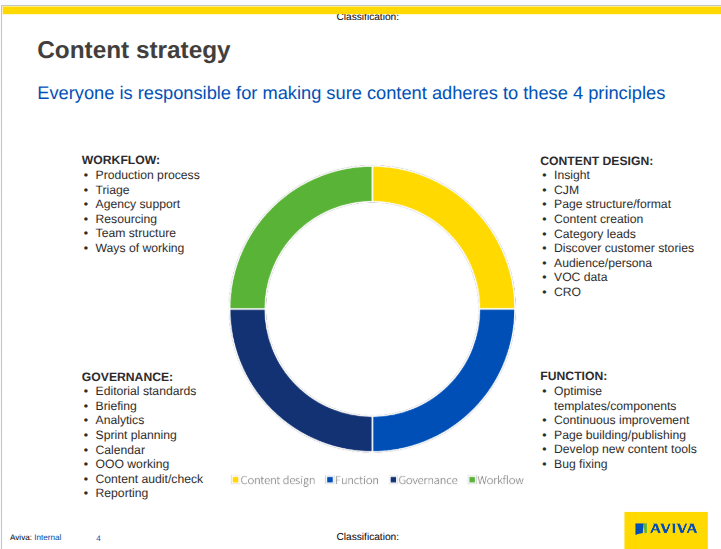
The first thing I did was set about putting together a strategy with a mission statement and vision. To deliver against this strategy, I included:
- Resources
- People
- Workflow
- Governance
Strategy
If you think you can lead a team (or company) without a strategy, you're setting yourself up to fail.
We can all have targets we want to meet, like clearing £XX million in profit per year, gaining market share, etc. But what's the long-term vision? Of course, this has to be led by the problem you're solving for the customer.
No customers, no business.
Luckily, Aviva has an established customer base of over 20 million. An extensive portfolio of insurance and investment products for B2C and B2B.
I was the owner of the website and social channels at this point.
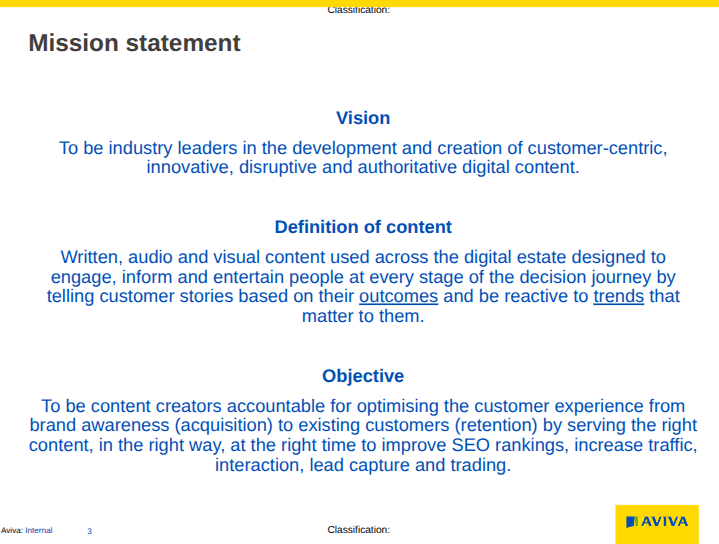
So the content team had a lot of ground to cover. This was my vision for the team.
The next stage was making sure I had the team, budget and resources to deliver this.
Resources
The website was not fit for purpose. It was bloated, confused and, with multiple Product Owners, there were broken journeys. Most importantly, the website just wasn't able to host content in different formats, and the templates had to be butchered to make sure the right content appeared in the right place - offering a cohesive journey from amplification to signposting to warm-up content to deep-dive (long-form) content that led to purchase.
I briefed an agency called Jellyfish based in the Shard, London. The brief was in 4 parts:
- Redesign of templates and components to be content-led.
- Recommendations on the content hub (blog), as I felt it needed a purpose.
- Information architecture and taxonomy of the website.
- Audit of the existing content to decide whether to keep, kill or archive.
They did a phenomenal job researching, collating and recommending.
People
As with any company, hiring is tricky, especially when you have to evidence why you need them and get budget approved.
I already had a team of copywriters (I changed them to content designers) and content marketers (who I changed to content strategists). They got all the training and support needed. I had no complaints (to my face) about this change, as it seemed to fit in with individual ambition and aspiration.
I also had a team of production people to manage the workflow until the worst restructure I'd ever experienced, quickly followed by another equally painful reorg, took the production team and the CMS team out of my remit.
This left me with a huge gap.
Workflow
To manage the volume of work coming into the team and to have oversight over what was being delivered, I set up a very rudimentary demand management processes.
This centralised the briefing process by asking stakeholders to fill in a standard online form, which went to a centralised mailbox and was allocated by the production manager to the relevant person who had capacity.
The creative processes had a peer review round before it went to the stakeholder and two rounds of amends. Anything deemed scope creep had to be rebriefed and the clock restarted, but this rarely happened in the real world.
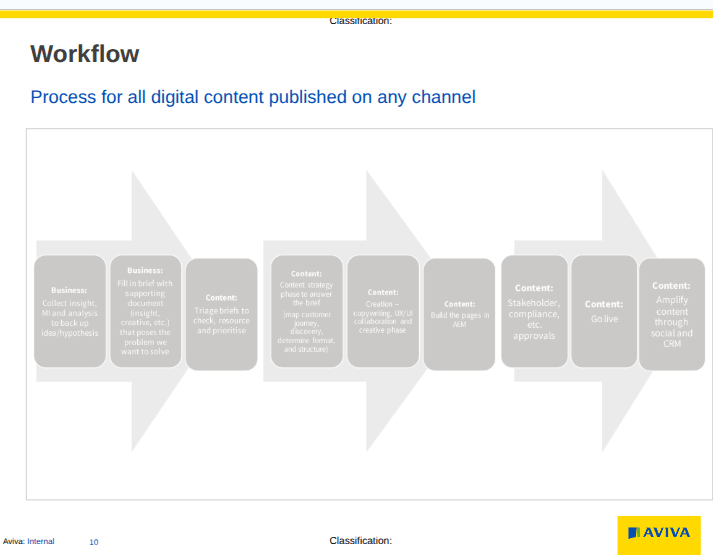
Once this was established, I could move it to phase 2. Going fully Agile.
Phase 3 was introducing Adobe Workfront. My business plan was approved. It was being implemented when I left.
I introduced Ceremonies with the whole team and 2-week Sprints.
We went through every brief, decided who would be best to deliver it given their skills and experience. Allocated Story Points (I insisted the team work to an 80:20 capacity), and all of this was tracked through Jira.
This tool was also great for making sure that the team were meeting their SLAs, tracking how much demand was going through the team and how long tasks were taking, so we could adjust the Story Point system.
Governance
I know this is sad, but it was my favourite bit!
I was the architect behind Aviva's global brand tone of voice.
In essence, I was tired of stepping into different organisations with near-identical TOVs.
So I banned the pillars clear, empathetic and friendly.
Using good old-fashioned behavioural science to make it memorable, distinctive and emotional, the partner agency, The Writer, came up with these pillars:

I also introduced an editorial strategy for the mid-funnel content, an in-house style guide and brand narratives.
There were also guidelines around what components were available, the taxonomy and accessibility.
The Result
They speak for themselves. Aviva's new website, with new TOV, saw an incremental uplift of 3% week-on-week.
The editorial strategy saw editorial content go from 25,000 readers a month to circa 70,000 a month, also increasing the dwell time from 1.7 minutes to 4 minutes.
I also had the lowest employee turnover in the Customer & Marketing department, consistently ranking in the top percentil for leadership, especially around feeling supported, having clear direction, inclusivity and job satifaction.
The blood, sweat and tears of Covid meant an overhaul of nearly all products, a new fraud reporting tool, as well as support content and new navigation to make it easier for customers to find what they needed without calling up (all ideated and planned by me, delivered by the team). This was recognised by Kagool, which ranked Aviva number 1 in the FTSE100 in digital Covid response.
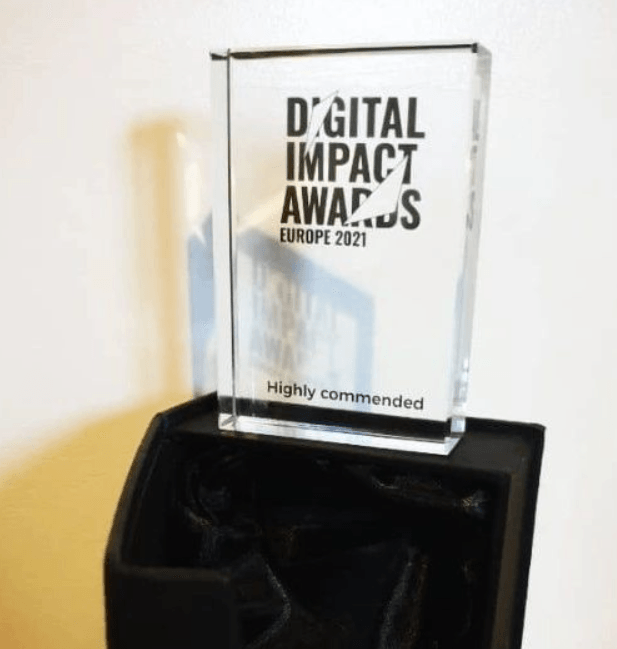
And winning at the Digital Impact Awards for my social media campaign supporting the Above-The-Line "you wouldn't believe it" ad with an 8-bit choose-your-own-adventure game on Instagram Stories.

There's a lot more, but I'm going to give away all of my secrets!
Lessons
- Agencies are invaluable for doing the research and recommendations, if you know how to brief them correctly and treat them as partners
- Bring your team on the journey. It's not enough to have the vision, the team need to believe in it and take ownership of parts of it.
- You won't always be popular with other teams. There's a fight as other teams bid for supremacy and empire-building. A fantastic line manager is gold (which I had until my final 18 months).
- Be humble. Utilise the talent in your team. Admit when you don't know. And be visible.
